
What Are the Benefits of Modular Cleanrooms?
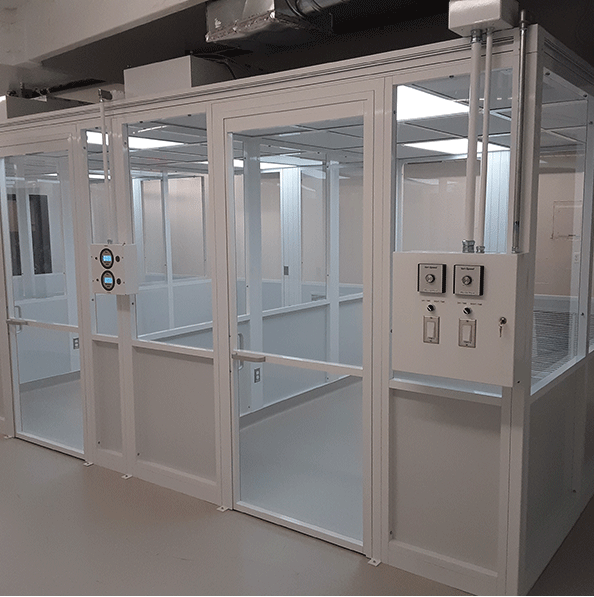
Modular cleanrooms offer a flexible, cost-effective solution for maintaining controlled environments across a wide range of industries, including pharmaceuticals, electronics, life sciences, and research laboratories. Compared to traditional stick-built cleanrooms, modular cleanroom systems provide significant advantages in terms of cost, scalability, installation speed, and long-term usability.
Whether you’re aiming for ISO 14644 compliance, FDA validation, or USP 797 adherence, a well-designed modular cleanroom can get you up and running faster without compromising performance.
1. Fast and Flexible Installation
One of the most compelling benefits of modular cleanrooms is the rapid installation process. Unlike conventional cleanrooms that require full construction and significant downtime, modular cleanrooms use prefabricated components, including wall panels, ceilings, doors, and FFUs, that can be installed in a matter of days or even hours, depending on the complexity.
Technical Air Products’ proprietary LogiClean® design ensures that our modular cleanrooms are not only fast to install, but also easy to expand or reconfigure. If you need to add a gowning room, increase square footage, or upgrade cleanroom classification, modular construction makes it possible without tearing down and starting over.
2. Cost Savings and Capital Efficiency
Modular cleanrooms can significantly reduce both upfront and ongoing costs:
- Lower initial investment: Modular systems typically cost less than custom stick-built rooms.
- Tax advantages: Since modular cleanrooms are not considered permanent structures, they often qualify for shorter depreciation schedules.
- Reduced operational disruptions: Minimal site preparation means lower labor costs and faster time-to-operation.
Technical Air Products offers energy-efficient cleanroom equipment, including low-watt LED lighting and high-efficiency fan filter units (FFUs), to help reduce power consumption and HVAC load over time.
3. Simplified Maintenance and Expansion
Because modular cleanroom components are standardized and field-assembled, maintenance is far easier than with traditional builds. Panels, doors, and accessories can be replaced or upgraded without demolition or extensive downtime.
Our cleanroom systems are designed for field flexibility, making them ideal for evolving production processes, growing lab environments, or changing regulatory requirements. Whether you’re scaling up or retrofitting, modular construction offers ongoing value.
4. High-Performance Contamination Control
Modular cleanrooms from Technical Air Products meet or exceed ISO 14644-1 standards for air cleanliness. Depending on your needs, we offer both HEPA and ULPA-filtered fan filter units (FFUs), including roomside replaceable options for ease of service and reduced contamination risk during maintenance.
Both our softwall cleanrooms and rigidwall cleanrooms can be configured to meet ISO 8 to ISO 4 classifications. Rigidwall options also serve as a cost-effective solution for USP 797 compliance in pharmaceutical or compounding applications.
5. Adaptability for a Range of Applications
Modular cleanrooms are used across a variety of industries and applications:
- Pharmaceutical manufacturing
- Biotech and life sciences
- Semiconductor and electronics production
- University research labs
- Aerospace and defense
With available accessories like pass-through cabinets, gowning rooms, and integrated air pressure systems, modular cleanrooms provide the infrastructure you need to meet strict environmental standards without the limitations of permanent construction.
Why Choose Technical Air Products Modular Cleanrooms?
At Technical Air Products, we specialize in designing cleanroom systems that balance performance, compliance, and flexibility. Our modular cleanrooms are engineered to meet your regulatory requirements while remaining adaptable to your future needs.
Learn more about our:
Or request a quote for a cleanroom solution that meets your ISO classification, airflow needs, and facility constraints.
Modular Cleanroom FAQs
What is a modular cleanroom?
A modular cleanroom is a controlled environment built using prefabricated components such as wall panels, ceilings, and fan filter units (FFUs). Unlike traditional cleanrooms, modular cleanrooms can be quickly installed, easily reconfigured, and relocated as needed.
How long does it take to install a modular cleanroom?
Installation time depends on the size and complexity of the system, but most modular cleanrooms can be assembled in a few days. Smaller softwall cleanrooms may be operational within a single day, while larger rigidwall systems might take up to a week.
Are modular cleanrooms ISO compliant?
Yes, modular cleanrooms can be designed to meet ISO 14644-1 standards for cleanliness, ranging from ISO Class 8 to ISO Class 4. Proper fan filter unit (FFU) placement and air change rates are key to meeting compliance requirements.
What industries use modular cleanrooms?
Modular cleanrooms are used in pharmaceuticals, biotechnology, electronics manufacturing, aerospace, life sciences, research institutions, and more. Their adaptability makes them ideal for changing regulatory or operational needs.
Can modular cleanrooms be expanded or moved?
Absolutely. One of the major benefits of modular cleanrooms is flexibility. You can expand, downsize, or relocate the cleanroom by reusing the same modular components—without needing to rebuild from scratch.
How do modular cleanrooms compare to traditional cleanrooms?
Modular cleanrooms are typically faster to install, more cost-effective, and easier to maintain than traditional stick-built cleanrooms. They also offer more flexibility for future reconfiguration or upgrades.
What kind of filtration systems are used in modular cleanrooms?
Technical Air Products offers cleanrooms equipped with HEPA and ULPA fan filter units, including roomside replaceable models for simplified maintenance. These units help maintain strict air cleanliness levels required by ISO, FDA, and USP standards.
Leave a Reply