
Benefits of Roomside Replaceable Fan Filter Units
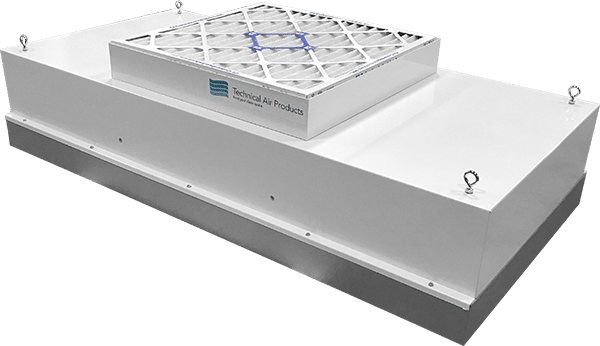
Maintaining an environment free from contaminants is crucial in industries like biotech, pharmaceutical, and semiconductor manufacturing. In order to achieve the required level of cleanliness, fan filter units (FFU’s) are used within the cleanroom environment. Roomside replaceable (RSR) fan filter units offer a number of operational advantages over standard fan filter units. Let’s talk about what these are and why your organization should choose RSR units for your cleanroom.
The Roomside Replaceable Difference
What is the difference between a standard FFU and a roomside replaceable FFU?
The function of all FFU’s is to filter out particles and contaminants from the air, maintaining the stringent cleanliness standards required in critical environments. FFU’s are equipped with high-efficiency particulate air (HEPA) or ultra-low penetration air (ULPA) filters, which are capable of trapping particles as small as 0.3 microns with a 99.97% efficiency for HEPA and even greater for ULPA filters.
However, unlike standard FFU’s, RSR FFU’s allow for filter replacement from within the room. To replace a filter on a standard FFU, a worker has to access the cleanroom ceiling outside of the room, remove the unit, and then replace the filter. This means that the cleanroom must be shut down during this maintenance period. Afterwards the room must be recertified to make sure that it operates according to the necessary cleanliness standards.
Cost-Effective and Time-Efficient Maintenance
Traditional FFU maintenance often requires extensive downtime. It can be labor-intensive, involving scaffolding or lift equipment to access the unit from above the ceiling. In contrast, RSR FFU’s are designed for quick and easy filter replacement from the room side. This drastically reduces downtime and labor costs.
This design not only simplifies the maintenance process but also makes it safer to accomplish, as it reduces the need for maintenance personnel to scale high ladders or use heavy equipment. Additionally, the ability to quickly replace filters means that cleanroom operations can resume sooner, minimizing the impact on productivity.
On average, a HEPA filter will last between 3-5 years. In some cases, a filter may last longer, depending on how often the pre-filter is changed and how dirty the operating environment is. This means that every 3-5 years, a cleanroom with standard fan filter units will have to be shut down, serviced, and re-certified. This is expensive, both in actual costs and in opportunity cost. With roomside replaceable units, the room can remain continuously operational and will not have to be re-certified.
The design of roomside replaceable fan filter units promotes enhanced cleanliness and operational efficiency. Additionally, they are just simpler to use and much more hassle free. At Technical Air Products we often recommend that organizations invest in RSR FFU’s because we know that time is money. There’s never a good time to shut down operations and have to re-certify a cleanroom. Roomside replaceable units will make your cleanroom maintenance much easier and at a relatively low cost.
As always, if you have any questions about cleanroom components or what your cleanroom design should entail, please contact us. We will be happy to answer them.
FAQ: Roomside Replaceable FFUs
Q: What is a fan filter unit (FFU)?
A fan filter unit (FFU) is a self-contained air filtration system typically installed in cleanroom ceilings. It draws in air from above, filters out contaminants using HEPA or ULPA filters, and recirculates clean air back into the room to maintain ISO-compliant air quality.
Q: What makes a roomside replaceable FFU different from a standard FFU?
The key difference is accessibility. Standard FFUs require access from above the ceiling for filter changes, often requiring scaffolding and downtime. RSR FFUs, on the other hand, allow filters to be replaced directly from inside the cleanroom. This eliminates the need to dismantle the ceiling or shut down operations.
Q: Why choose roomside replaceable FFUs for your cleanroom?
- Minimizes downtime – No need to shut down the cleanroom for maintenance
- Reduces labor costs – Easier access means quicker filter replacements
- Improves safety – No ladders or lifts needed for above-ceiling access
- Avoids re-certification – The cleanroom stays sealed during maintenance
Q: How long do HEPA filters in FFUs typically last?
On average, HEPA filters last 3 to 5 years, depending on usage and environmental conditions. Regularly replacing prefilters can extend HEPA filter lifespan.
Q: Do RSR FFUs require the cleanroom to be shut down during filter replacement?
No. Because maintenance occurs from inside the room, the cleanroom remains sealed, avoiding downtime and the need for re-certification.
Q: Are RSR FFUs compatible with both HEPA and ULPA filters?
Yes. RSR units are available with either HEPA or ULPA filters, depending on the cleanliness level required by your ISO classification.
Q: Are RSR FFUs more expensive than standard FFUs?
While the initial cost may be slightly higher, RSR FFUs offer significant long-term savings by minimizing operational disruptions, labor costs, and the need for re-certification.
Q: Which industries benefit most from roomside replaceable FFUs?
Industries with high standards for contamination control, such as biotech, pharmaceutical manufacturing, semiconductor fabrication, and medical device production, benefit greatly from RSR FFUs.
Leave a Reply